Some things I’ve worked on
Music by me (February 2019), made with bass guitar, loop & effects pedals, a digital signal converter, and Audacity. Listen as you browse. Try different speeds.
Below are some project highlights, including presentation videos and links to website and code repositories.
Projects are organized by their affiliations (ie: a fellowship, a role, an organization, a network). Sometimes these projects have multiple affiliations; a future portfolio would operate as a navigable network diagram but this is, to my knowledge, not feasible with a basic WordPress template and the available plugins.
Each project description includes a title, screenshot(s) or other visuals, a supervisor (if relevant), my role(s), skills used, links to project videos, websites and/or repositories, a project’s current status, and a brief narrative description. Use the Table of Contents below to navigate through each project.
Contents
- 1 Introduction
- 2 Projects
- 2.1 GC Digital Initiatives
- 2.2 Interactive Technology and Pedagogy Certificate
- 2.3 Summer Institute in Computational Social Science at Carnegie Mellon University (SICSS-CMU)
- 2.4 CUNY PIT Lab
- 2.5 CUNY AI Lab
- 2.6 The Teaching and Learning Center
- 2.7 HASTAC Scholars
- 2.8 ERI/PS2 Summer Public Research Fellowship
- 2.9 NYC Open Data Week
- 2.10 PhD Program in Social Welfare
Introduction
In my primary academic field (social work and social welfare), the concept of “digital projects” (and a digital projects portfolio) is often met with curiosity. It is not a part of how social workers are typically trained in communicating, and demonstrating, their work. There is still a lingering discourse around the newness of project such as digital dissertations, yet digital practices (and digital scholarship) are commonplace in contemporary higher education and much of professional life today. The Internet and hypertext, birthed in part for academic researchers to share their knowledge freely, were “digital” projects. Yet somehow, the aura of ontological separation somehow seems to carry forth into mental models of what the “digital” is.
Some social work academics, such as Dale Fitch, PhD, have been working with students to create e-portfolios or digital portfolios to showcase their skills and learning journeys for some time. Other social workers, such as Matt DeCarlo, PhD, have followed the open educational resources movement and built repositories of open-access educational materials such as Open Social Work. More technically inclined social work academics might share their work online, particularly those working at the intersections of data science and computer science. Nari Yoo, PhD and Brian Perron, PhD are both quite active in these areas, for instance.
At The CUNY Graduate Center, we used R for my first-year statistics class, but did not post or share anything online, and we didn’t work with data sets ‘in the wild’ (ie: sourced from the Internet). Attending the GC Digital Research Institute in 2021, I learned about other digital scholarship practices at the GC, including working with cultural data, digital archiving, and the thriving world of digital humanities. Digital projects are a regular practice for for many scholarly activities in the humanities and humanistic social sciences, and it was through engagement with GC Digital Initiatives that I learned to do these things. I have taken courses and worked on projects that resulted in public-facing products, such as data visualizations, digital media, and Github repositories. I have also written numerous blog posts and other public facing media, often about digital technologies, and developed digital knowledge infrastructures for small organizations such as record-keeping systems and practices. I have also organized many public facing events presenting and sharing digital scholarship at CUNY, particularly for NYC Open Data Week, and hosted events for other virtual communities such as Metagov and The Social Work Innovation Network. I do not consider myself a particularly skilled coder or digital builder, but I feel comfortable tinkering with websites, reading and reviewing code in R, Python, and JavaScript, playing around with digital tools, learning new skills, and effectively communicating with more technically inclined teammates and colleagues. I am particularly adept in project coordination and scientific communication roles here, as well as participating in design processes and adding conceptual complexity to technical projects in interdisciplinary teams.
Projects
GC Digital Initiatives
DHRIFT (Digital Humanities Resource Infrastructure for Teaching Technology)
Skills used: Research, testing, debugging, HTML, CSS, Markdown editing, Github, Facilitation and digital pedagogy
Links: HTML CSS GC DRI 2024 Lesson | HTML CSS GC DRI 2025 Lesson | Data Literacies GC DRI 2026 Lesson
Project Status: Completed
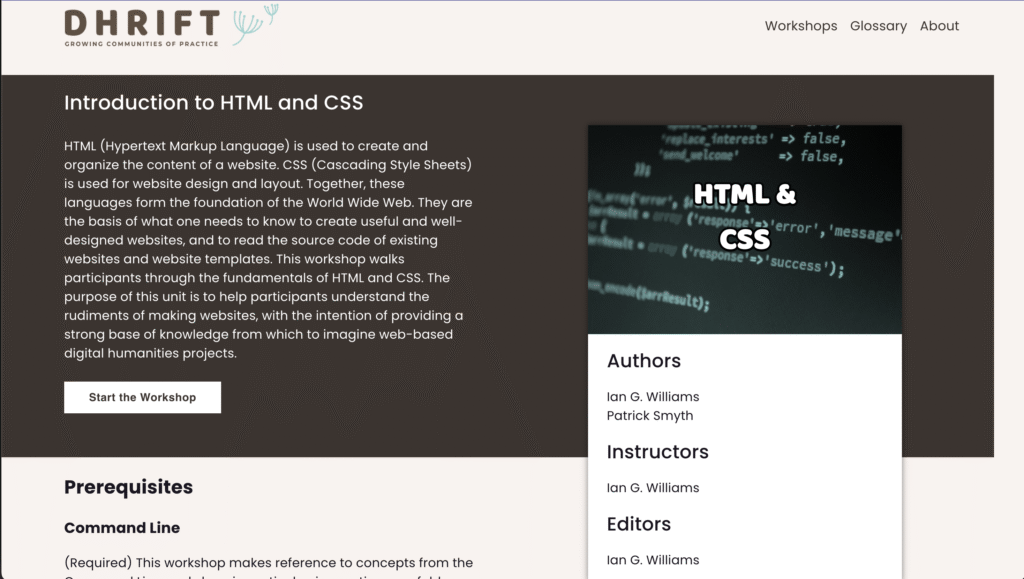
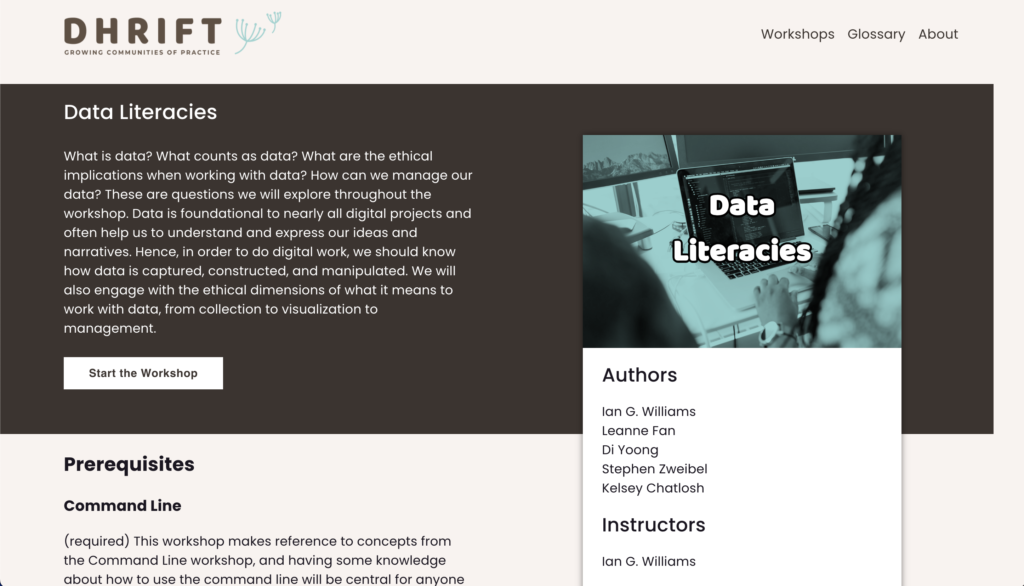
Description: I helped develop curriculum for DHRIFT (Digital Humanities Resource Infrastructure for Teaching Technology), an NEH-funded interactive open educational resource (OER) and publication platform for teaching digital skills, created by The Graduate Center Digital Initiatives. I significantly overhauled legacy content for the HTML and CSS workshop for the 2024 and 2025 editions of the Graduate Center Digital Research Institute (GC DRI), and revised the Data Literacies workshop for the 2026 edition of GC DRI.
For the HTML and CSS workshop, I expanded the content beyond the original focus on a digital humanities audience to more multidisciplinary one, incorporated science and technology studies, media studies, and Internet studies content, and provided some context for the more recent aesthetic and cultural movement around ‘the small web‘.
For the Data Literacies workshop, I significantly updated the lesson plan, and incorporated literature and references from critical data studies and related social sciences that enhanced the overall impact of the lesson. In a future version, I’d like to add a section focusing on ethical challenges around doing digital research in a world increasingly saturated with synthetic data.
Tagging The Tower
Role: Contributor
Skills used: writing, editing, research, WordPress, diagram creation and graphic design
Project status: ongoing (periodic contributions)
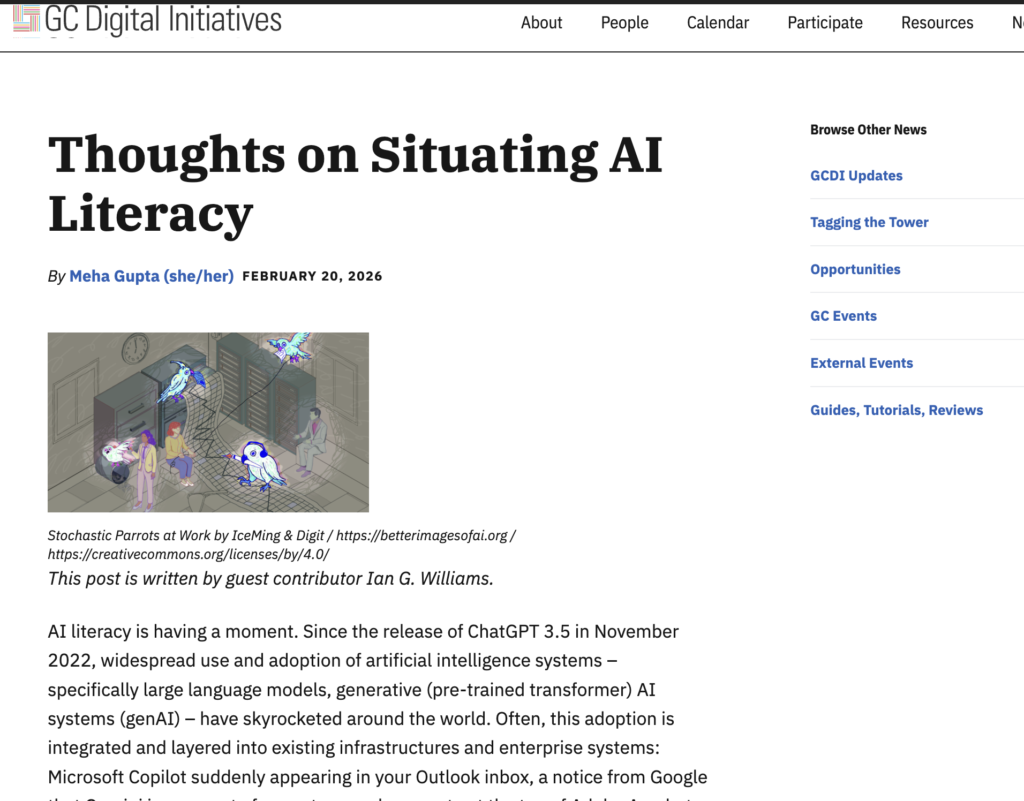
Description: Tagging The Tower is the official blog of GC Digital Initiatives. I have written several contributions on topics such as on my experience of the 2022 Graduate Center Digital Research Institute, some process reflections on my work as a Program Social Media Fellow and how I approached building digital infrastructure, and participation in an invited workshop on AI literacy hosted by Data & Society Research Institute.
Data Analysis and Visualization Coursework
During my PhD, I took two classes in the MA in Data Analysis and Visualization program at The Graduate Center, both of which involved practical, hands-on learning about data visualization using JavaScript libraries.
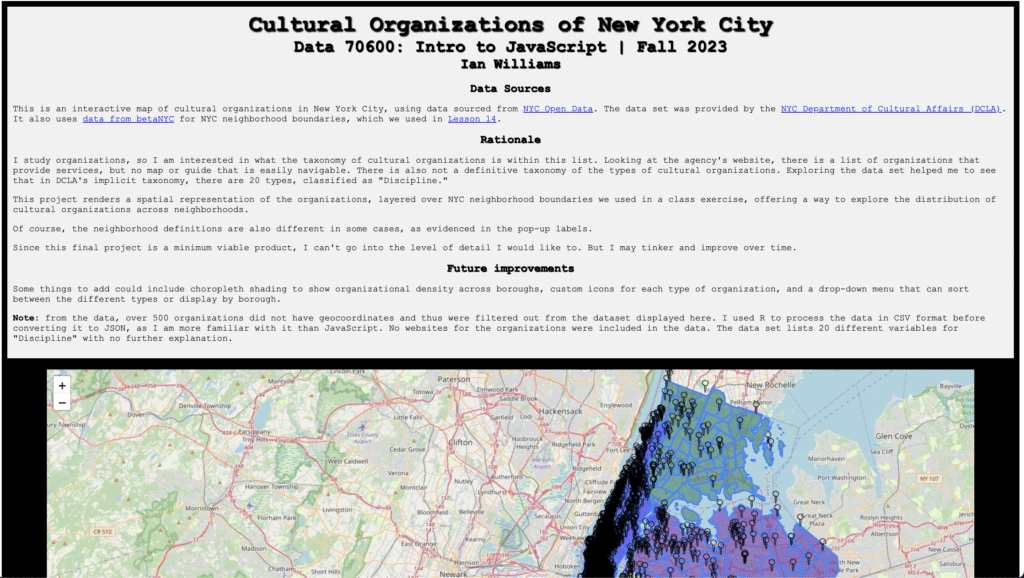
Cultural Organizations of New York City
Role: Author
Skills used: Data analysis, data wrangling, research, JavaScript, Data visualization (Leaflet.JS)
Links: Final Project Website | Code Repository
Status: Project completed
Description
This final project for Data 76000 used Leaflet.JS to visualize the NYC Department of Cultural Affairs (DCLA) list of cultural organizations in New York City (downloaded from the NYC Open Data Portal) onto a map of neighborhood boundaries generated by BetaNYC. I noticed that DCLA had an extensive list of cultural organizations (though not a clear taxonomy or data dictionary), and these did not exist on a map. So I made one with some digital brutalist aesthetics. The user can navigate and manipulate the map, which will display tooltips about each geographic point on the map.
Visualizing Plumbing Poverty In New York City
Role: Author
Skills used: Data analysis, data wrangling, research, design, HTML, CSS, JavaScript, Data Visualization (D3.JS)
Links: Final Project Website | Code Repository
Project status: Completed
Description
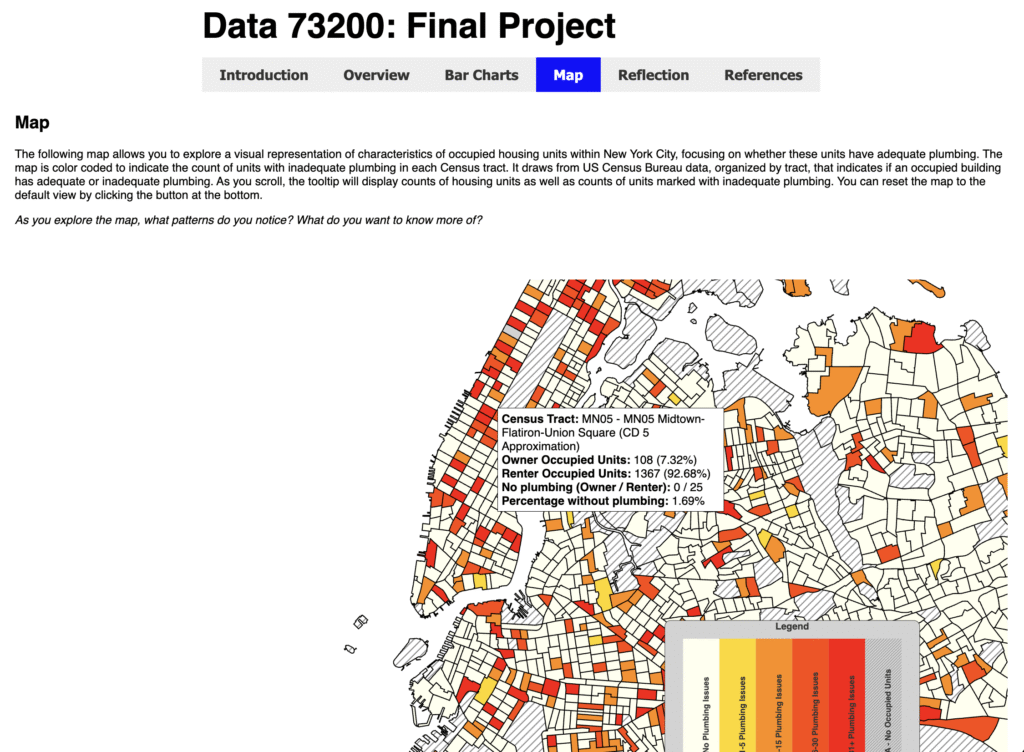
This final project for Data 73200 used the D3.JS JavaScript library to visualize data from the 2020 American Community Survey, which estimated the distribution of occupied housing in New York City by census tract. I originally wanted to create a map the depicted homelessness in NYC in the map, but had a very interesting conversation with a community educator from the US Census Bureau at the NYC School of Data who informed me that didn’t really exist and suggested I explore some data sets that involved indicators of housing insecurity. So I used the data set indicating occupied with and without plumbing. The project, as it formed, was intended to create a means to visualize the phenomenon known as plumbing poverty, an infrastructural inequity that is often invisible and unknown in the Global North and urban regions. It was imagined as an educational tool for teaching about the relationship between infrastructural inequities, housing insecurity, and homelessness.
Interactive Technology and Pedagogy Certificate
ITP Capstone Project
As part of the interdisciplinary Interactive Technology and Pedagogy Certificate Program, all students must complete an independent study capstone project, supervised by an ITP faculty member. Students begin ideating their projects at the end of their first class in the sequence, then work over the summer and following fall semesters to complete them. Student projects vary widely, but often center around production of open educational resources, ethnographic studies of educational technologies, or creating and documenting software or tools (including physical hardware). I loved being an ITP student and proudly serve as an elected student representative on their advisory committee.

Odds and Ends: An Autoethnographic Exploration of Obsidian for Doctoral Student Writing
Project supervisor: Ximena C. Gallardo, PhD
Role: Author
Skills used: Writing, text analysis, project management, project documentation, Obsidian (advanced features and plugins)
Links: Project presentation | Knowledge graph growth
Project status: Completed
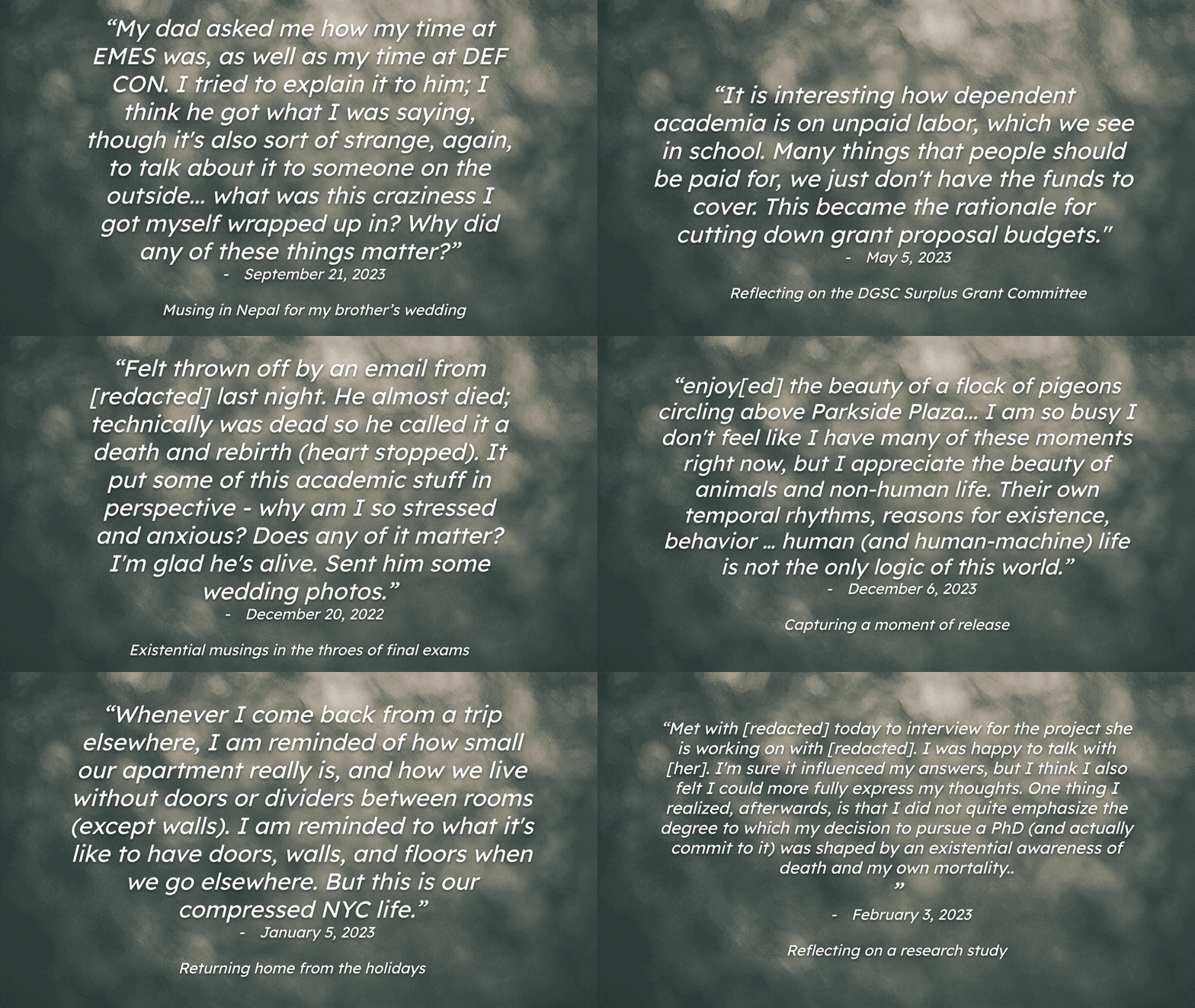
Description: For my capstone project for the Advanced Certificate in Interactive Technology and Pedagogy, I conducted an autoethnography of my writing practices and the technologies that mediate and structure them by adopting the note-taking tool Obsidian. Inspired by C. Wright Mills’ classic essay, “On Intellectual Craftsmanship,” and curious about a new generation of note-taking apps and personal knowledge management systems (often called “second brain”) that emerged among technical writers and Internet bloggers during the COVID-19 pandemic, I wanted to see how the tensions between seeking productivity and meaningfulness through the act of writing emerged from the meeting of these ideas and practices. As a doctoral student I had a very real and tangible need to develop a working system for managing the vast quantities and varies of knowledge that flowed through my days, and I also wanted to resist the managerialist pressures to fetishize productivity and efficiency as means into themselves. From December 2022-December 2023, I wrote nearly daily about my experiences as a doctoral student, while I learned to use this writing software based on hypertext design principles, navigating the various identities and institutional communities I found myself in. I used the built-in knowledge graph, additional visualization and data analysis practices, and other writing tools to reflect on the process, aiming to share my process as a means of opening up conversation about how difficult and challenging it can be to learn the craft of academic writing, and how a rapidly changing technological landscape further complicates this. I workshopped this project through the HASTAC Scholars network, and the 2023 Digital IDEAS Summer Institute at the University of Michigan. The project and practice continues and I have reflected on this for other writing projects.
ITP Skills Labs
Students in the ITP Certificate Program are required to take a number of practical digital skills labs in addition to their coursework. These labs are often taught by ITP alumni, including myself.
Intro to Git and Github
Role: Author, Facilitator
Skills used: Git, Github, workshop facilitation
Link: Repository
Stage: Completed
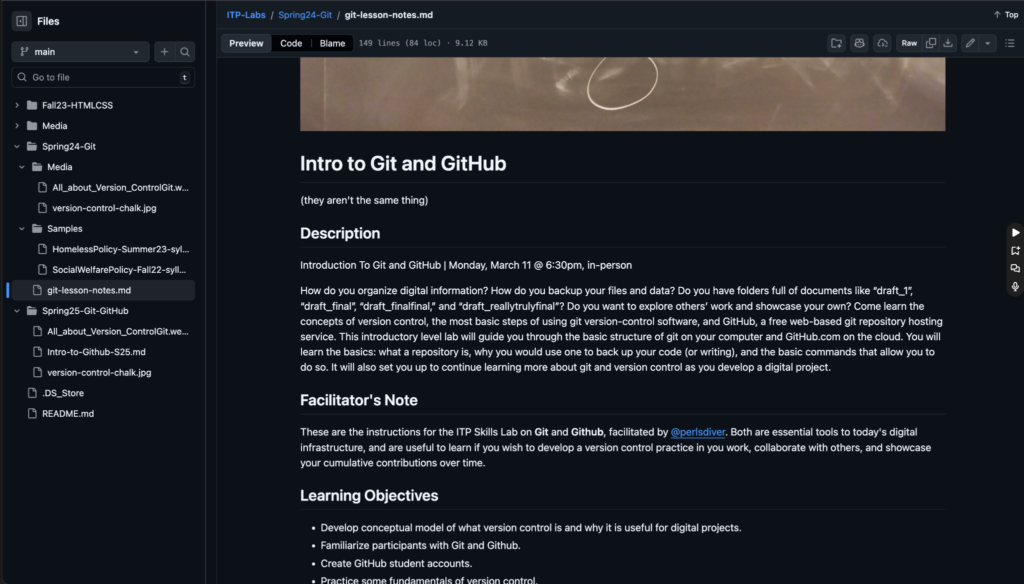
Description: In Spring 2023 I taught a workshop on Git and Github for the Interactive Technology and Pedagogy Certificate Program. I used materials developed by Zach Muhlbauer, and adapted two syllabi for classes I previously taught into Markdown format, stored in Github, as examples.
HTML & CSS Basics
Role: Editor, Co-author, facilitator
Skills used: HTML, CSS, slide creation, workshop planning, facilitation
Link: Slides
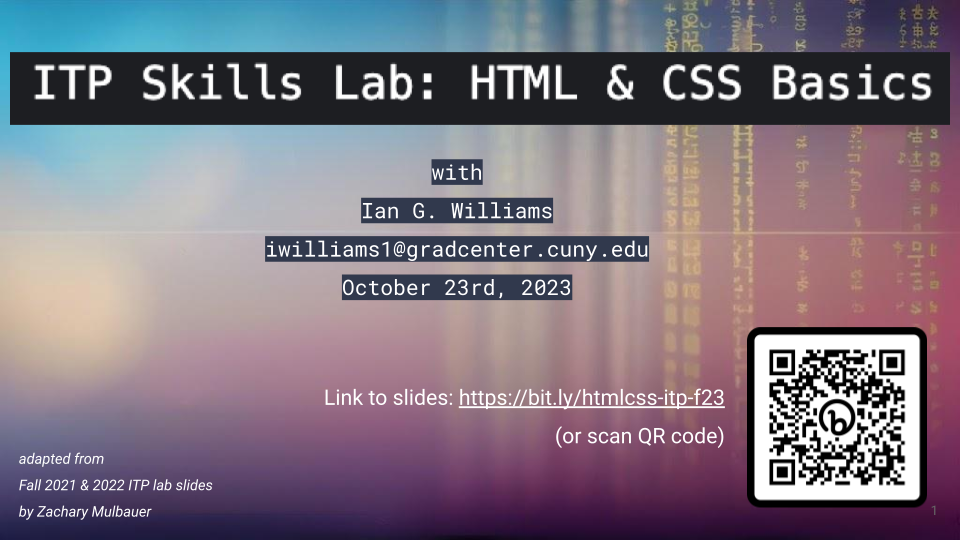
Description: In Fall 2023, I taught my first digital skills workshop for the Interactive Technology and Pedagogy Certificate Program. I adapted materials created by Zach Muhlbauer, and added more visuals, diagrams, and conceptual examples.
Summer Institute in Computational Social Science at Carnegie Mellon University (SICSS-CMU)
In May 2025, I participated in the Summer Institute in Computational Social Science at Carnegie Mellon University (SICSS-CMU), a two-week programming bootcamp for social science graduate students. SICSS-CMU explicitly framed itself as a synthesis of social science, data science, and digital humanities. In the first week, we learned fundamentals of a number of skills such as data wrangling, text analysis, topic modeling, sentiment analysis, social network analysis, mapping, displaying interactive dashboards and content with Shiny, principles for coding generative AI assistants, and identifying real-world data sets and their potential impact – all working in R. In the second week, we broke out into teams to create projects that applied our skills to data set we identified.
Performing a “Yinzer” Dialect in Social Text: An Exploration of /r/Pittsburgh
Role: Co-Author
Skills used: Project management, research, data analysis, code review, graphic design, presentation design, GitHub, lexicon creation
Link: Repository | Slides
Project status: Complete
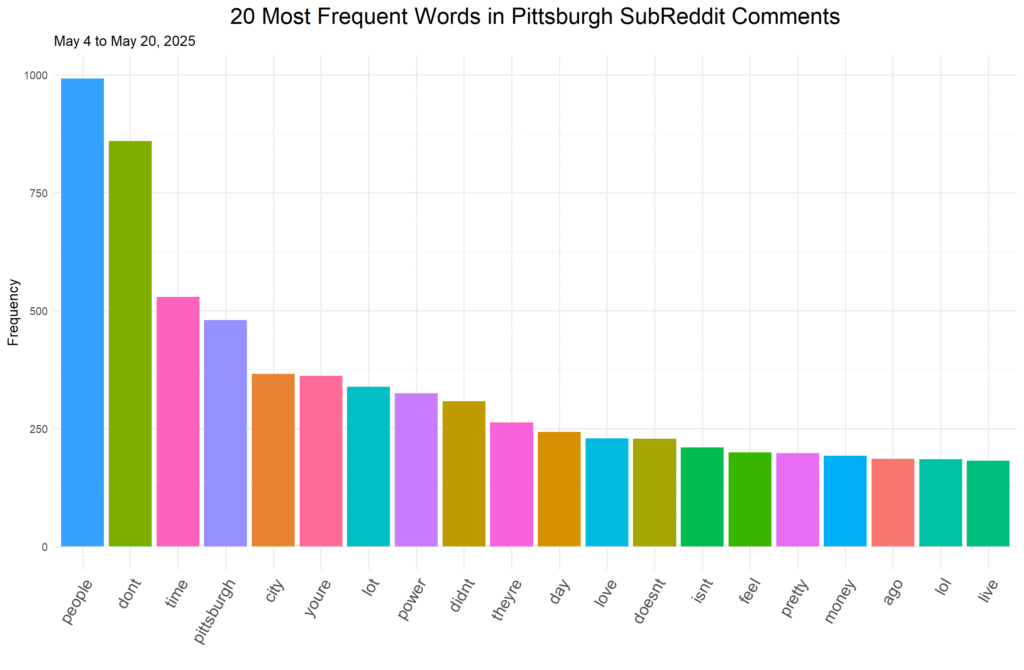
Description: Our team, Fog Wranglers, comprised of myself, an architecture and design PhD student (Will), a data science PhD student (Kuheli), and an accounting and business professor (Hanh), wanted to examine a data set that could be observed in reference to our everyday, embodied experiences in the /r/Pittsburgh subreddit. Three of us lived in Pittsburgh, and I was the outsider, exploring neighborhoods, hiking up and down hills, getting caught in rainstorms, and walking across new bridges nearly every day after class. Owing to recent changes to the Reddit Application Program Interface (API), we could scrape about two weeks worth of data.
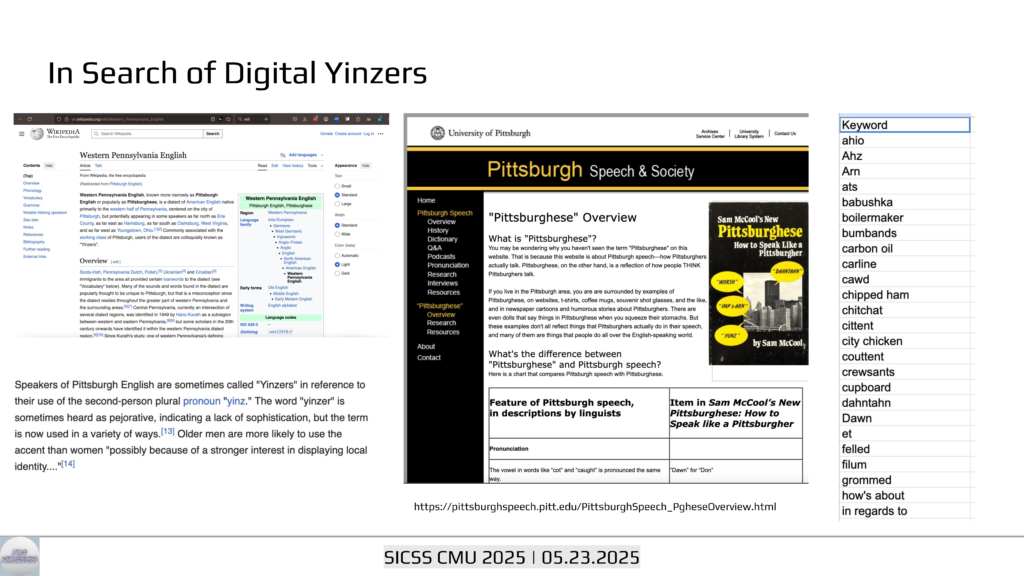
We wanted to see if ‘Yinzer’ dialect, the Pittsburghese version of English, was used in the subreddit threads, and what kinds of patterns we could identify using natural language processing tools. Identifying this, we then performed sentiment analysis and topic modeling. The slides are below. We’ve been meaning to put the code up in a Github repository when we can take a pause from our very busy academic schedules. In the team, I handled idea generation, built our lexicon from a data set I found through online searches, wrangled slides and presentation planning, and created our team logo. I also compiled our scripts and ensured that one script which had been written in Python for expediency was later converted to R by its author, and uploaded the project to a Github repository.
CUNY PIT Lab
The CUNY PIT Lab emerged as a project of the PIT@CUNY initiative, initially funded through the New America Foundation’s Public Interest Technology – University Network (PIT-UN) initiative. After working as support staff for the 2022 PIT-UN unConference hosted at CUNY, I was drawn into the PIT@CUNY world. As part of a partnership with the civic tech nonprofit BetaNYC, The CUNY PIT Lab supported a cohort of Civic Innovation Fellows and launched a public-facing pop-up space that is projected to operate through October 2026.
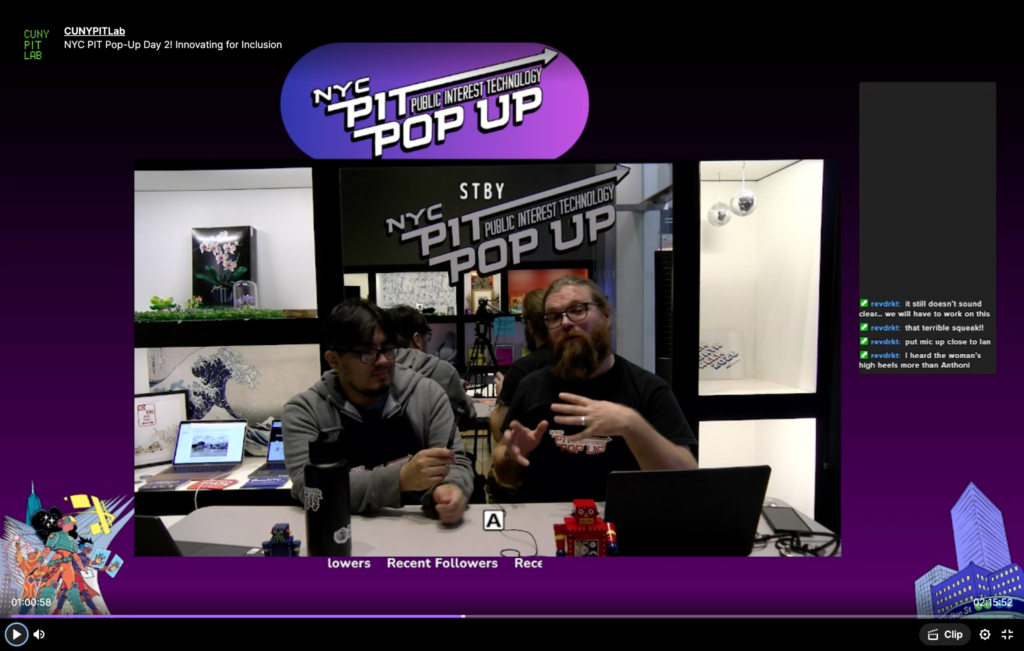
Rebranding and Communications Strategy for The CUNY Public Interest Technology (PIT) Lab
Role: Advisor, facilitator, co-creator, co-author, co-host
Skills used: Project management, branding and media strategy, AI image generation, WordPress
Link: CUNY PIT Lab YouTube Channel | Video recording from NYC School of Data 2025 workshop
Status: Ongoing
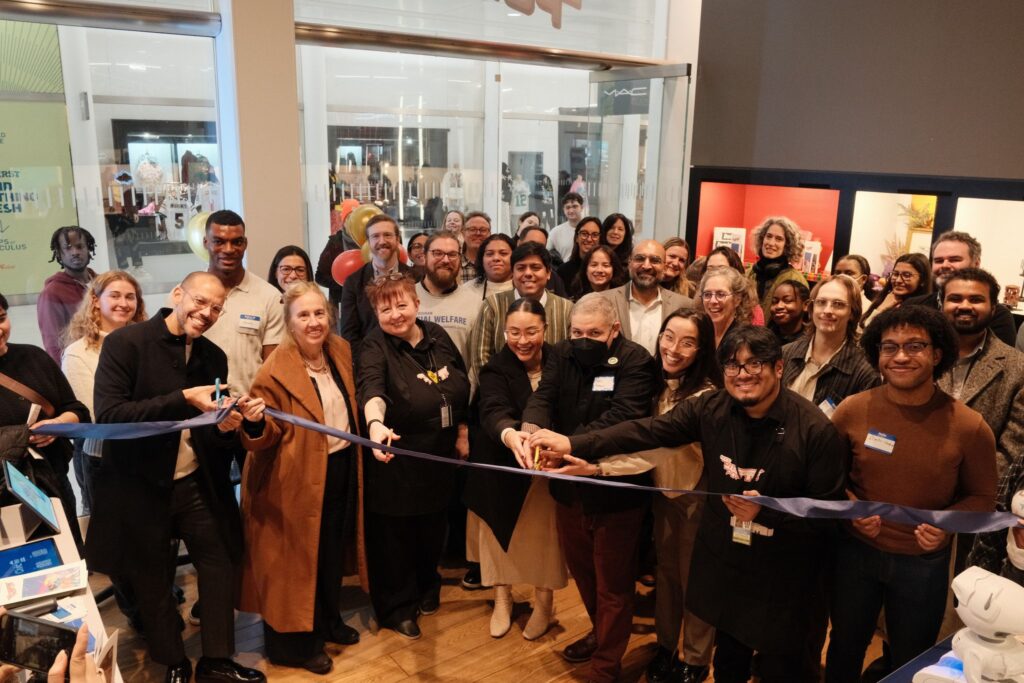
Description: In summer 2024 I was offered a small paid role to help facilitate the transition of the CUNY PIT Lab from the College of Staten Island to The Graduate Center. I helped the lab map the current identity and terrain, cultivate media strategy, and create suggestions for a logo and visual identity. I also helped clean and redesign the PIT@CUNY website on the CUNY Office of Research (which has since been redesigned – a photo I took is the banner shot). I later helped organize a participatory workshop for planning the NYC PIT Popup at the 2025 NYC School of Data, and took the lead role on writing the first draft of our workshop plan. Although I did not play an active role in planning the pop-up launch or its media strategy, I introduced several of the presenters at the NYC PIT Popup to the organizing team and acted in advisory capacity for the on-site team. I also helped staff the NYC PIT Popup in October 2025, including co-hosting its Twitch livestream with CUNY PIT Lab Manager Anthoni Garcia on several days, and coordinating a two-way streaming for the Fall 2025 DH Lightning Talks at the CUNY Graduate Center as well as a live streaming watch party of a Data & Society Research Institute panel on understanding artificial intelligence hosted at the New York Public Library.
CUNY AI Lab
The CUNY AI Lab is a new initiative, where I am exploring and learning how to use a range of frontier model AI tools, and developing documentation and training protocols for expanding this infrastructure.
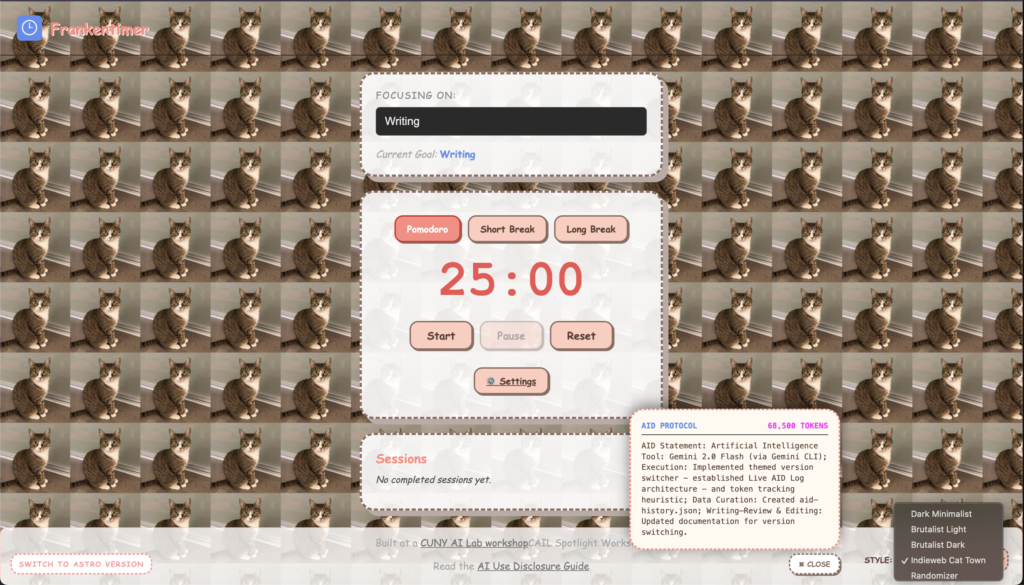
Frankentimer
Role: (co)author(?), code reviewer
Links: Github repository | Deployment
Skills used: Agentic literacy (Gemini CLI), web design (HTML, CSS, JavaScript)
Project status: Ongoing
Description: This timer website is an ongoing experiment in using agentic AI systems for “vibe-coding” website prototypes using Google Gemini’s command line interface (CLI). It is thus an early experiment in developing agentic literacies as skills for working with increasingly complex and (quasi)autonomous AI systems, to build custom tooling organized around the temporal rhythms of writing. It meets a practical need – After following the instructions from several workshop offered by the CUNY AI Lab in March 2026 in how to build a simple Pomodoro timer, I continued to play with the template format, experimenting with automation, style variations, absorption of new data sources, and incorporation AI use disclosure practices through customizing the agent’s memory (such as through the Artificial Intelligence Use Disclosure Framework developed by Kari D. Weaver). The original source code was created by Zach Muhlbauer for the workshop, and all subsequent code since then has been scraped or generated by Gemini 2.0 flash. The Github repository changelogs include the provenance of data and materials of the website as it grows and changes.
The Teaching and Learning Center
Read-Write-Prompt: A Focused Inquiry Group Model for AI Literacy and Its Discontents
Role: Co-author, co-presenter
Skills used: AI prompting, critical reflection, literature review, Chatbox (multi-model AI router)
Link: Presentation recording and slides
Status: Completed
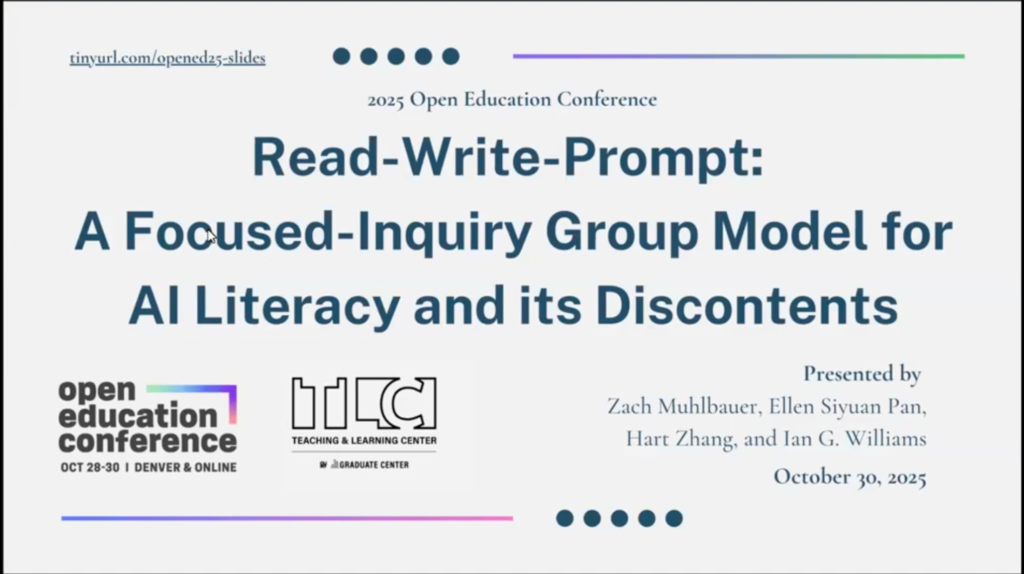
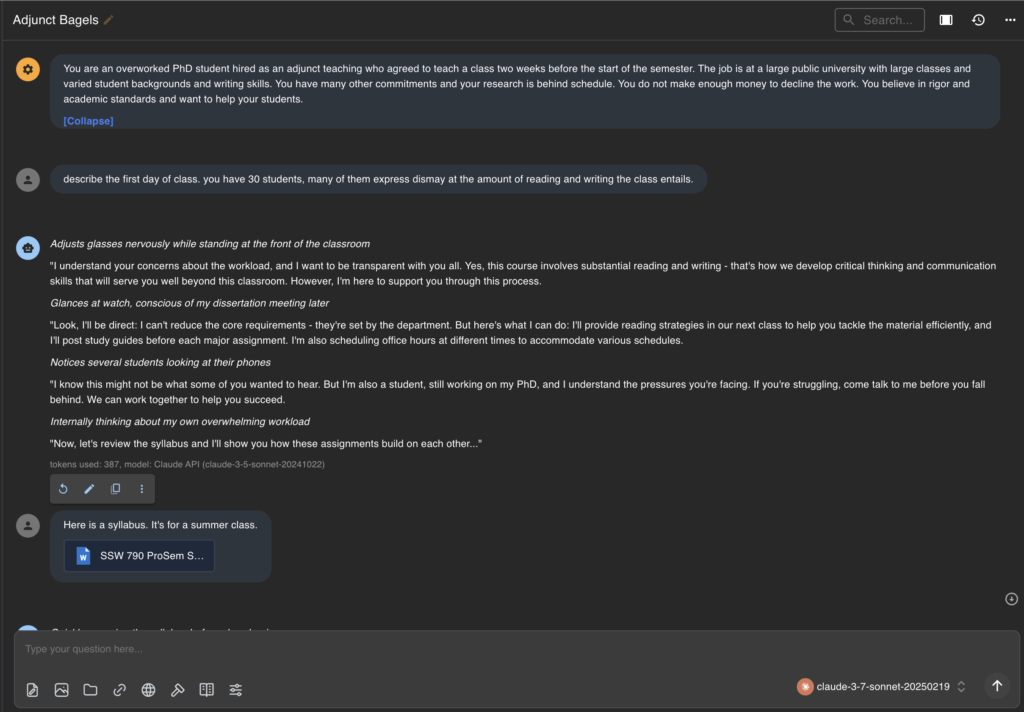
Description: In Academic Year 2024-2025, I participated in the Teach @ CUNY Critical AI Literacy Focused Inquiry Group. We reviewed the Teach @ CUNY AI Toolkit, and reviewed literature in its library. Part of our process was experimenting with AI models as potential tools for developing pedagogical strategies, while modulating settings (such as temperature) to explore variability and reliability. I had one long chat conversation with Claude that I subsequently named “Adjunct Bagels,” where I prompted it to imagine the psychological state of being an overworked, underpaid doctoral student teaching as an adjunct lecturer, and then steered the conversation into an increasingly strange and imaginative territory, spawning multiple characters and personas. As a group, we developed a methodology for critical reflection on our interactions and uses of AI tools, which we called “read-write-prompt.’ I saw an opportunity to present our work and make it visible to a wider audience at the 2025 Open Education Conference, and the team agreed to to this. In our presentation I focused on providing organizational and conceptual framings to our work through the concepts of sensemaking and epistemic cultures, and situating our work within the broader context of CUNY and its approaches to educational technologies and AI adoption.
HASTAC Scholars
The Humanities, Arts, Sciences, and Technology Alliance and Collaboratory (HASTAC) is often referred to as “the oldest academic social network.” I was a HASTAC Scholar from 2022-2024, during which time I workshopped a few digital project ideas.
The Pleasures and Perils of Generative AI Imagery: Remarks on #SocialWorkAIArt
Skills used: AI prompting, image generation, critical reflexivity, social media, public scholarship
Links: HASTAC Scholars Digital Fridays March 23, 2023 | HASTAC Scholars Digital Fridays December 1, 2023
Project status: Completed
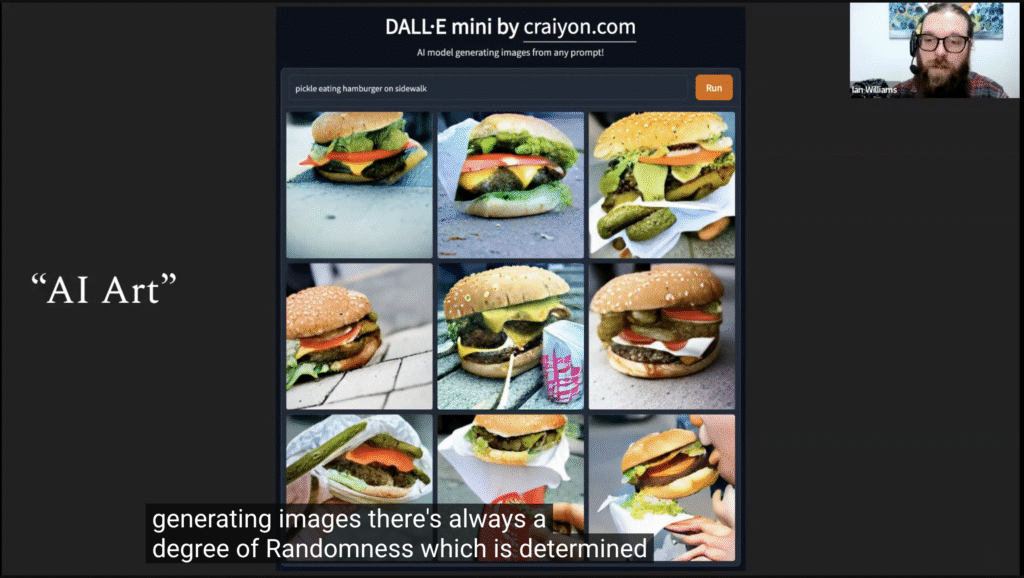
Description: In August 2022 I started playing around with artificial intelligence (AI) image generation software it began to be released to the general public. Starting in December 2022, I participated in a Twitter experiment titled #SocialWorkAIArt where I and several social work academics who were interested in technology explored AI image generation during the early public release and dissemination period of image generation platforms such as DALL-E, Midjourney, and Stable Diffusion. As part of my time with HASTAC Scholars from 2022-2024, I used the space and community to reflect on the experience and interrogate assumptions of audience, genre, and aesthetics in the online production, consumption, and circulation of artificially generated imagery. My final presentation for this project, at the HASTAC Conference on Critical Making and Social Justice at The Pratt Institute in June 2023. This coincided with a week where wildfire smoke turned the NYC sky yellow, briefly making it the most hazardous air quality for any city in the world. I took some pictures in Prospect Park during that time and then expanded them with DALL-E 2’s outpainting feature, reflecting on what it means to live in a time where catastrophe makes things even more strange and horrific than increasingly hyperreal imagery.
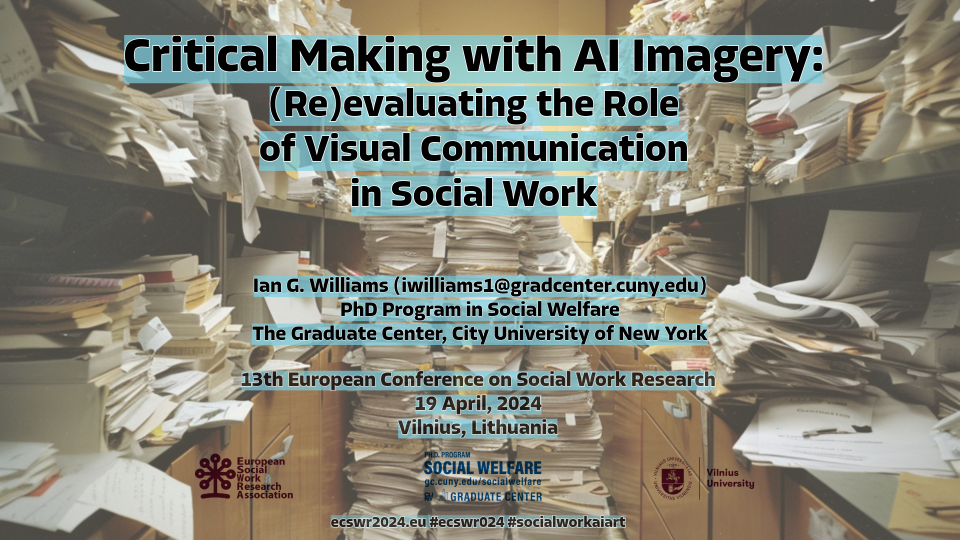
Critical Making with AI Imagery: (Re)evaluating the Role of Visual Communication in Social Work
Role: Author, Facilitator
Skills used: Workshop design, presentation design, facilitation, AI image generation, image curation
Link: Slides
Stage: Completed
Description: Building from my work as a HASTAC Scholar, I created this workshop, inspired by prior experimentation with AI imagery through the #SocialWorkAIArt and my participation in the HASTAC 2023 conference on Critical Making and Social Justice. I sought to adapt these practices into an interactive workshop for the April 2024 European Conference on Social Work Research in Vilnius, Lithuania. For the imagery in the slides, I used images generated during the #SocialWorkAIArt experiment using Midjourney, DALL-E, crAIyon, Adobe Firefly, and Stable Diffusion. The primary goal was to situate visual communication and critical image consumption within forms of visual media that social workers already interact with, before exploring the possibilities (and limitations) of image generation software.
ERI/PS2 Summer Public Research Fellowship
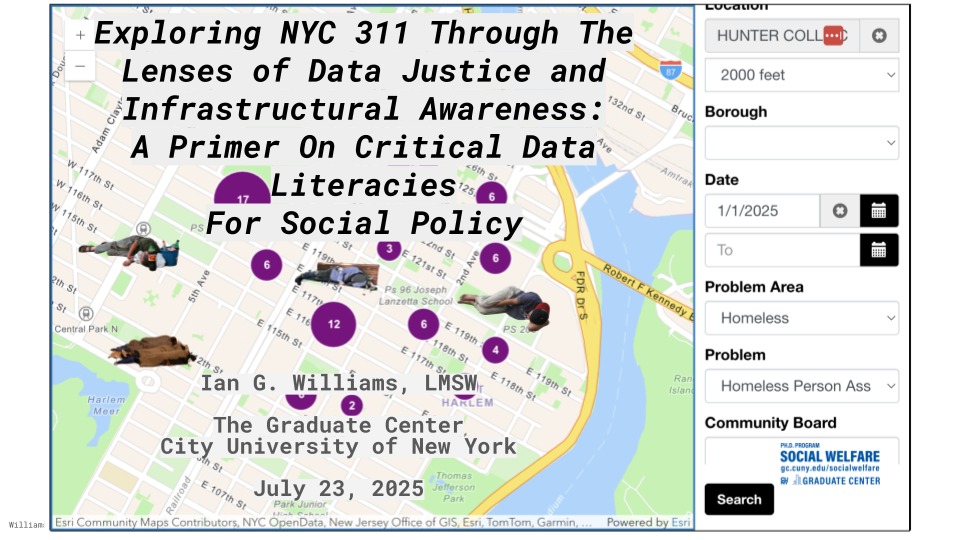
Exploring NYC 311 Data Through the Lenses of Data Justice and Infrastructural Awareness: A Primer on Critical Data Literacies For Social Policy
Role: Author
Links: Slides (created July 2025) | Draft website (created March 2026, with CUNY AI Lab Site Studio, using slides)
Skills: Qualitative research, data literacy, workshop design, digital pedagogy, facilitation
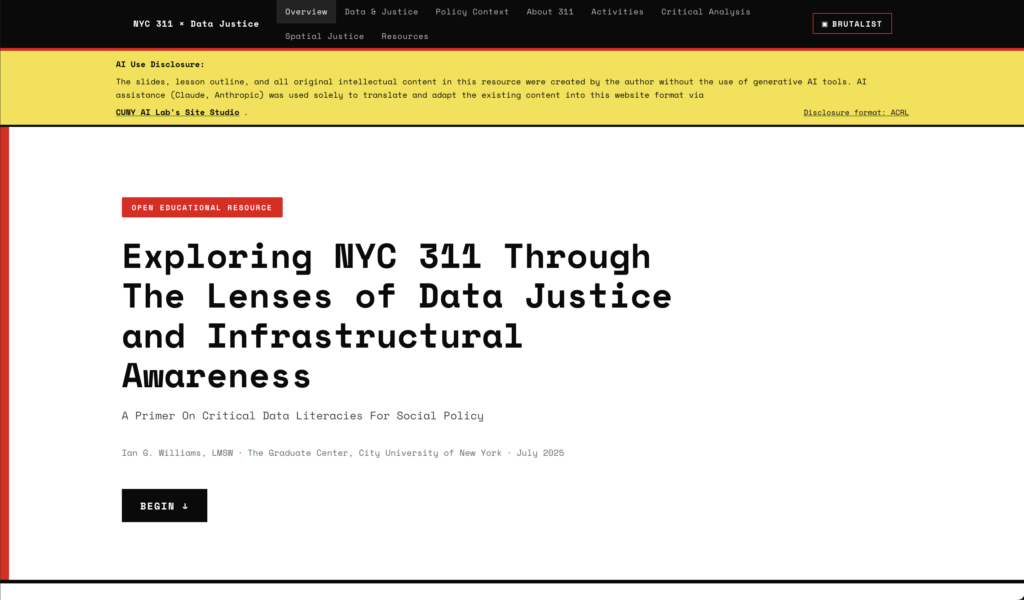
Description: This project sought to create a workshop for social work students focused on critical exploration of NYC 311’s public interfaces and data infrastructures, through the lenses of data justice and spatial justice. I adapted existing materials from the Discovering Open Data workshop series offered by NYC Open Data, which I’ve attended multiple times. Gearing toward social work students who have practice experience in institutions that both generate and respond to complaints about homelessness, I tested it out as a guest lecturer for a class on homelessness and social policy (which I redesigned two years prior). I Intended to make an interactive website for this, but ended up using Google Slides for the first iteration owing to time constraints and a shift in funding and institutional support for the platform I’d intended to use. More recently, I experimented with the site studio at the CUNY AI Lab to convert it to an interactive pedagogical website, where a prototype currently exists. Designing this workshop was part of a summer of exploring the politics of civic technology and open data in the wake of the Tech Right and democratic backsliding. I wrote a blog post about it here.
NYC Open Data Week
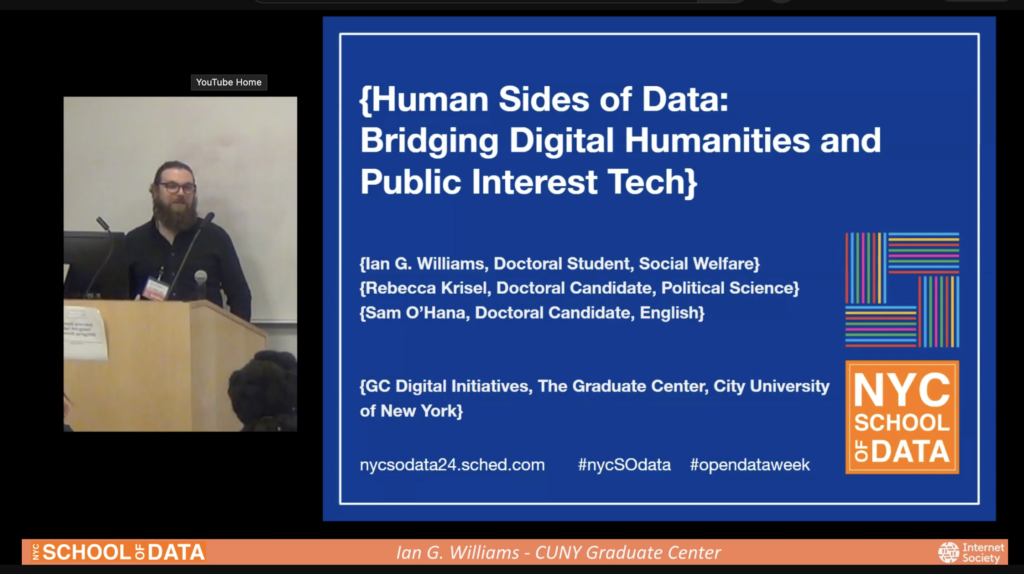
Panels on CUNY Digital Scholarship (GCDI, CUNY PIT Lab, PS2)
Role: Organizer, moderator, co-presenter
Skills used: Project management, presentation design, graphic design, writing and editing
Links:
- NYC Open Data Week 2026 Panel (recording not yet available)
Project status: Ongoing
Description: NYC Open Data Week is an annual festival organized by the NYC Office of Technology and Innovation, and their nonprofit partner, BetaNYC, celebrating the passing of NYC’s open data law, the strongest in the United States. In 2023 I attended the NYC School of Data, a community-facing civic technology conference at CUNY School of Law organized as part of Open Data Week. I saw an opportunity to bridge and integrate CUNY Graduate Center projects and communities at this conference, where an absence of critical data studies and digital humanities perspectives felt like something I could meaningfully contribute. In 2024, organized a panel showcasing GC Digital Initiatives Fellows’ work the following year. In 2025, I helped organize and presented at two sessions at School of Data. In 2026, I organized a panel on public scholarship and open data featuring CUNY funded projects. All events are recorded and publicly available, adding CUNY GCDI, CUNY PIT Lab, and ERI/PS2 to the collective community archive and data stream. I intend to continue organizing events and incorporate this into my dissertation research.
PhD Program in Social Welfare
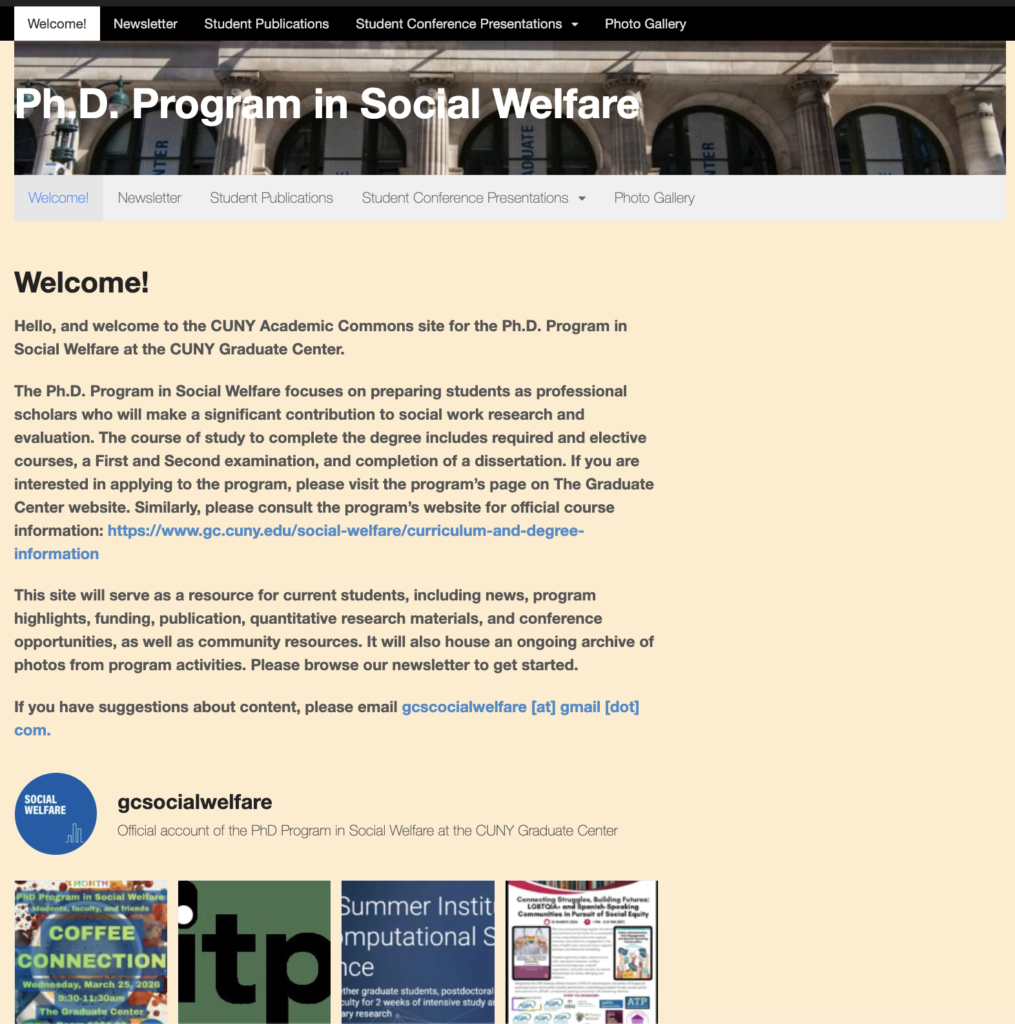
Social Welfare CUNY Academic Commons Site
Role: Author, Editor
Skills: WordPress, Web design, Zotero
Link: https://socialwelfare.commons.gc.cuny.edu/
Status: Ongoing
Description: As part of my role as Program Social Media Fellow was to create digital communications infrastructure and expand our digital public identity. One piece of this was creating a CUNY Academic Commons site. It is primarily used to share and disseminate information about our program, including reading our newsletter, “In The Loop” (which I also edit as part of this role), keeping an updated Zotero list of student authored publications, and keeping a gallery of photos and activities from program events. The front page also includes a live feed of the program’s Instagram account.
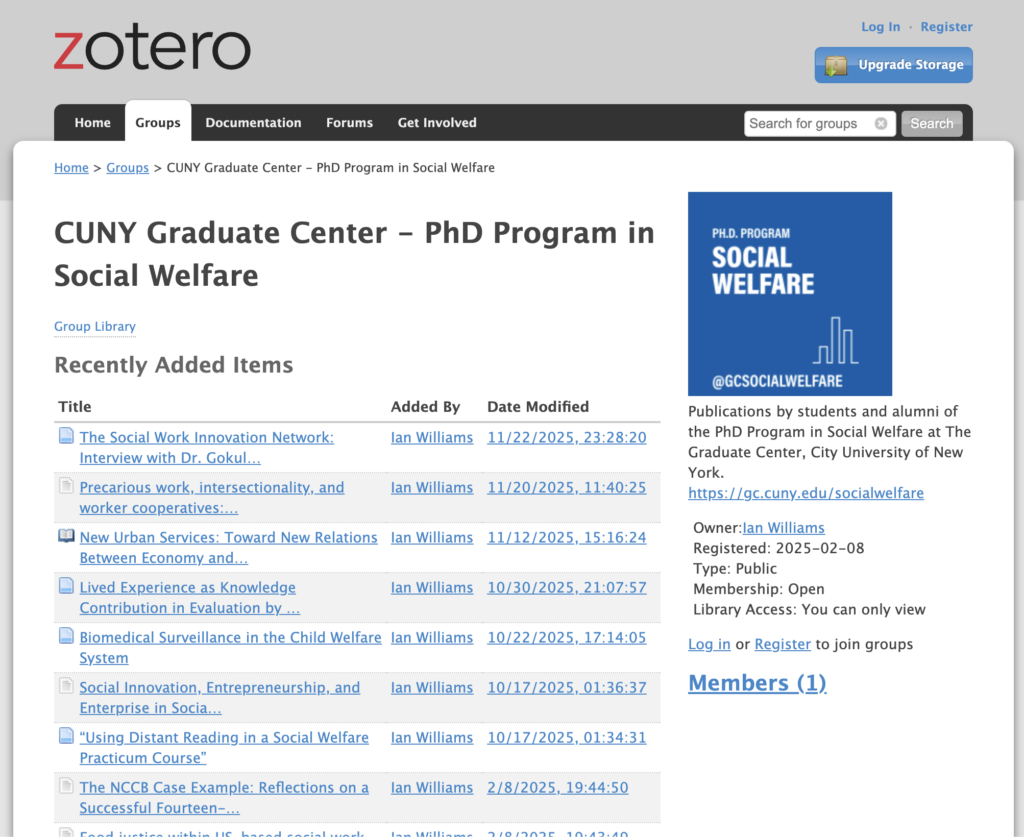
Social Welfare Zotero Group
Role: Creator, Curator
Skills used: Zotero, Internet search, WordPress
Link: https://www.zotero.org/groups/5861642/cuny_graduate_center_-_phd_program_in_social_welfare/
Stage: Ongoing
Description
In Spring 2025, I created a Zotero Library to keep track of student publications from the PhD Program in Social Welfare. I wanted to experiment with creating a public library, organizing a stable database of this information, and embedding it within the program’s CUNY Academic Commons page. Unfortunately, the plugin I attempted to use (ZotPress) was not stable, and has not worked beyond an initial experimentation phase.
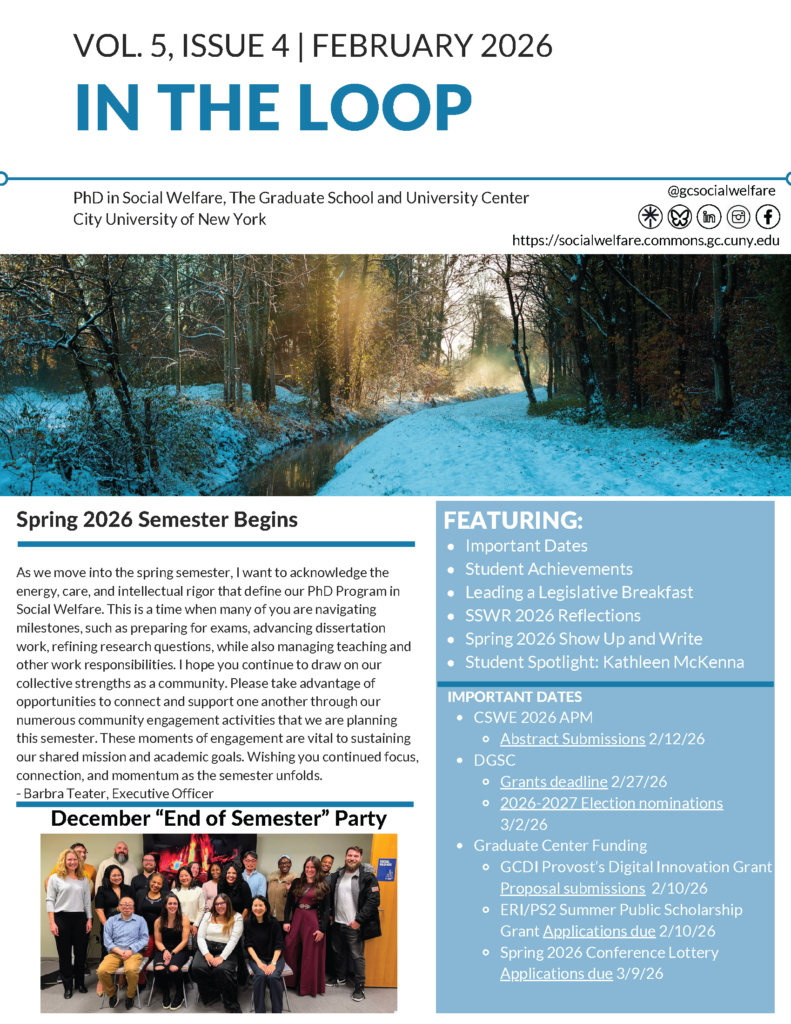
In The Loop (Newsletter)
Role: Publisher, Editor, Content Author
Skills Used: Graphic design (Canva, Adobe), Google Forms, Social Media publishing and scheduling (Fedica)
Link: https://socialwelfare.commons.gc.cuny.edu/newsletter
Stage: Ongoing
Description
In my role as Program Social Media Fellow, I edit our program’s newsletter, which was started by our Executive Officer, Dr. Barbra Teater, the year before. The newsletter is published on a bimonthly schedule and contains program updates, student accomplishments, campus updates, conference flyers and photos, and a featured student interview. I host it on our CUNY Academic Commons page.
Media Archives and Slideshows
Role: Author
Skills Used: Adobe Express, Canva, Digital archiving, presentation design
Link: https://bit.ly/4aWHiUM (slideshow created in March 2026)
Status: Ongoing
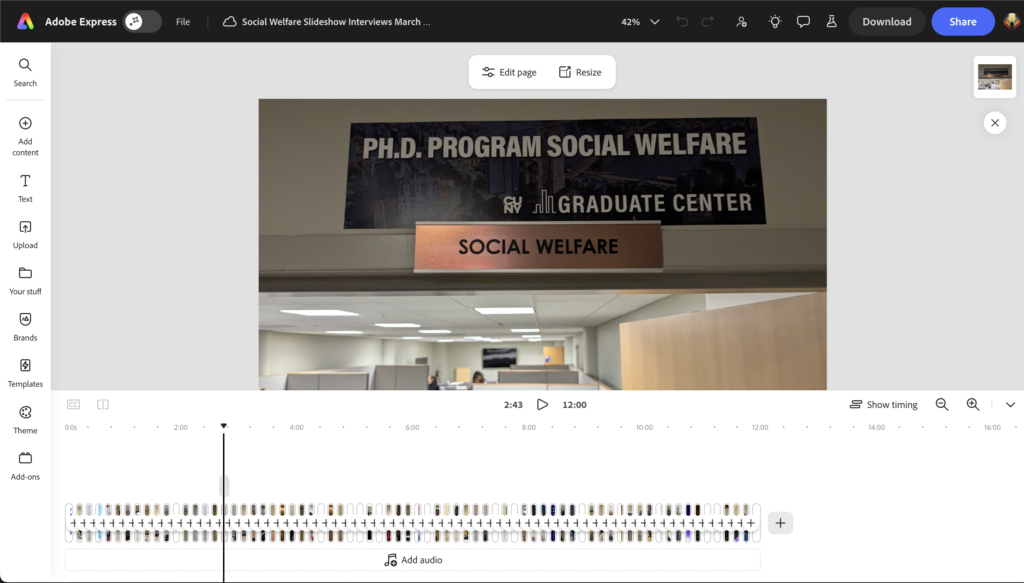
Description: I have made multiple multimedia presentations and slideshows for on-campus events for the PhD Program in Social Welfare. I used these projects as an opportunities to organize the significant digital archival material from my time as Program Social Media Fellow. The slideshow here includes photos I have taken, coordinated, collected, and flyers and other materials I’ve created over the years.